Old-School Elders Reveal a 3-Step Daily Practice That Helps Nigerian Adults Restore Stable Blood Pressure Readings When Their Daily Tablets Have Stopped Being Enough
You wake up before your alarm goes off.
Not because you are rested. But because your mind is already there — at the monitor on your bedside table — before your eyes are even fully open.
You reach for it before you reach for your phone. Before you reach for your slippers. Before you drink a single sip of water.
You wrap the cuff around your left arm. You sit still. You breathe slowly the way your doctor told you to. You press the button and wait.
Please. Please. Please let it be good this morning.
The numbers appear.
And your heart sinks.
158 over 96. Again. Or maybe 162 over 99. Or 147 over 91 — and that one almost felt like a victory, didn't it? Because at least it was not 160.
You sit there in your bedroom, in the half-dark, with that small machine in your hand, and you feel something you have never told anyone. Not your children. Not your spouse. Not even your doctor.
I am afraid. Every single morning, I am afraid.
You have been on medication for years. You started with one tablet. Then your doctor added a second one — "just to support the first." And sometime in the last few months, a third one appeared on your prescription. Three tablets. Every morning. Before food. Before anything.
You have done everything they told you.
You cut salt from your meals. You have been eating without any proper enjoyment for months now. No ofe onugbu the way your mother made it. No proper egusi. No groundnut soup with crayfish the way God intended. You measure everything. You watch everything. You avoid everything.
And the readings still refuse to cooperate.
You reduced stress — or you tried to. But how do you reduce stress when the BP reading itself is the source of the stress? When your very first act every morning is to check a machine that tells you whether your body is working against you or not?
This is not living. This is surviving. And I am not even sure I am doing that well.
You have been to private cardiologists. You have done echocardiograms. You have spent money on consultations that gave you adjusted prescriptions and lifestyle advice that does not account for the fact that you cook Nigerian food, eat Nigerian food, live a Nigerian life. Nobody has told you what to do about ofe akwu. Nobody has told you what groundnut soup does to your readings or what bitter kola really does when taken properly. They just say: "reduce red meat, reduce salt, exercise, reduce stress."
You check your blood pressure twice a day now. Morning and evening. And the evening readings are almost always the worst — after a full day of work, of family, of life.
You have not told your children how many tablets you take every morning. You give them the better of your two daily readings when they call to ask. You say "it's managing" when it is not managing at all.
You are privately terrified of stroke. You will not say the word out loud. But it lives in the back of your mind every single day.
My uncle had a stroke at 58. He never walked straight again.
My colleague's wife collapsed in the kitchen last year. She was 54.
I am 54.
You are not weak. You are not irresponsible. You have done everything right according to every system you were given. The system has simply stopped working for you. And nobody has told you there was something else.
Drop everything you are doing now and listen to every word I am about to say.
Our grandmothers did not have home BP monitors.
They did not have lisinopril or amlodipine. They did not have private cardiology consultations or echocardiograms. They did not sit in traffic worrying about their next prescription refill.
And yet — how many of the elders you knew growing up truly suffered from what we now call "BP"? How many of them were on three medications before they turned 60? The old people were not perfect. But they knew something about their bodies that we have slowly, quietly forgotten. They ate certain things in a certain way. They rested a certain way. They prepared specific plants and drinks that we have replaced with sweetened commercial versions that do nothing.
This method has been around for centuries. Quietly passed down in homes across Anambra, Imo, Ogun, Oyo, and beyond — not in textbooks, not in hospital corridors, but around kitchen fires and in morning routines that pre-dated the pharmaceutical era. It is not magic. It is not superstition. It is structure — specific, sequenced, daily structure — that Nigerian adults practised before blood pressure even had a clinical name.
Hi. My name is Ngozi.
First thing you should know about me — I am NOT a doctor, cardiologist, or health expert of any kind. I am an accountant from Lagos, originally from Anambra State. I have worked in financial services for over twenty years. I am a wife. I am a mother. And for the better part of four years, I was a woman who began every single morning by measuring her blood pressure and ending up with a knot in her stomach.
What I am about to share with you is not medical advice. It is my personal story — and the practical daily practice that turned my morning readings from the worst part of my day into something I no longer dread. I am sharing it because too many women and men my age are quietly suffering through exactly what I suffered through, and nobody is telling them about this.
I was at my office desk in Victoria Island when it happened.
It was a Tuesday in October 2020. I remember because we had just finished a quarterly audit review and I had barely slept the two nights before. I stood up from my chair to walk to the printer room — and the room tilted. I grabbed the desk. My colleague Amaka looked up and said: "Ngozi, your face —"
I did not hear the rest.
I came around in the ambulance. My blood pressure, they told me later, was 178 over 110 when the paramedics arrived. The doctor in the emergency room at the private hospital in Ikeja looked at me with the kind of careful, measured expression that tells you the news is not light.
"Mrs Ngozi, you have stage two hypertension. You should have been managing this already. We are starting you on lisinopril today."
I was 47 years old. I thought hypertension was something that happened to older people. To people who ate badly and never exercised. I walked. I watched what I ate. I was not that person.
But there I was.
The emotional cost of what followed was something no doctor warned me about.
My husband Obiora changed — not in the way husbands change when they become distant or unkind. He changed in the way that is almost worse: he became watchful. Quiet in a new way. He started paying attention to what I ordered at restaurants. He would glance at my plate at family dinners. He never said anything directly, but I could feel his eyes tracking me. The pressure of being watched by someone who loves you and is frightened for you — that is its own kind of stress.
My daughter Chisom, who is a nurse in Abuja, started calling every Sunday specifically to ask about my readings. "Mummy, what was it this morning? What was the evening one?" I began giving her only my best reading of the two. If the morning was 154/94 and the evening was 162/98, I told her: "It was 154, my dear. It is managing."
I was lying to my own daughter because I did not want her to worry. That is what this condition does to you. It makes you a keeper of secret numbers.
The breaking point came in early 2024.
My doctor in Ikeja — a good man, a careful doctor — looked at my results for the third time in two years and said words I had been dreading: "We need to add a third medication. The amlodipine is not doing enough alongside the lisinopril. I want to try a low-dose combination of something else."
I sat in his chair and I felt something cold move through me. Three tablets. I was now a person who takes three blood pressure tablets every morning. At 51 years old.
I drove home in silence. I did not tell Obiora immediately. I sat in the car in our compound for twenty minutes, just staring at the steering wheel.
If three medications cannot hold it steady — then what? What comes next? What is my body doing?
My older sister Ada had told me once: "Ngozi, these hospital people will give you tablet until your liver protests. There is more to life than tablet." I had dismissed it at the time. I trusted my doctor. I still trusted him — but sitting in that car, I began to understand what she meant.
Here is what I had already tried before that day — and why none of it worked.
I was on lisinopril from October 2020. It held my readings for about fourteen months — then the readings began creeping back up. My doctor added amlodipine in December 2022. That combination helped briefly, then plateaued. A third medication was introduced in early 2024. The medications kept changing. The readings kept finding their floor and then climbing again.
I tried a strict low-salt diet for eight months. My cook learned to prepare everything without salt. I stopped adding seasoning cubes. I stopped going near smoked fish at family events. My readings dropped by maybe 4-5 mmHg consistently — but they did not stabilise, and the diet was impossible to maintain perfectly at every family gathering, every church lunch, every celebration. The moment I had one normal meal, the readings spiked back.
I bought commercial zobo — the sweet bottled kind — from market vendors in Lekki Phase 1 after reading online that hibiscus tea reduces blood pressure. I drank it for six weeks. Nothing measurable happened to my readings. It was sweetened with so much sugar it probably made things worse.
I started chewing bitter kola. One daily, sometimes two. A roadside seller in my area told me it was good for the heart. I did this for three weeks — no structured protocol, just chewing. Inconsistent results. I abandoned it.
I joined a BP management WhatsApp group where various supplements were recommended. I spent ₦38,000 across three different supplement brands purchased online — CoQ10, magnesium, some imported herbal capsule someone swore by. None of them produced consistent improvement. The readings continued to do what they wanted.
I paid for two private cardiology consultations at ₦35,000 each. Both excellent doctors. Both adjusted my medication and gave lifestyle advice. Both told me to eat well, exercise, reduce stress. Neither told me what specific Nigerian foods actively supported blood vessel health. Neither gave me a structured daily protocol I could follow at home. The advice was good. The implementation in a real Nigerian life was impossible.
Now. Christmas 2023. Awka, Anambra State.
It was my first visit home in two years. I had been avoiding family gatherings because they always involved food I was not supposed to eat and questions I did not want to answer.
Christmas morning meal at my family compound. My sister had prepared ofe onugbu with stockfish. Fried meat. The smell alone almost broke me. I was sitting at the table with a small plate of mostly plain rice and vegetables, and I was not hiding it well.
My husband noticed first. He leaned over quietly: "Ngozi, you look pale. Please eat something."
From across the compound, I saw her watching me.
Mama Ekwueme. Eighty-three years old. Retired traditional birth attendant and community health elder from Awka. She had been seated at the head of the elders' table. Compact, bright-eyed, spine still straight at that age. She called me over after the meal was finished. Not urgently. Just: "Ngozi. Come and sit with me."
She did not ask me what medications I was on. She did not ask for my last reading. She looked at my face for a long moment and then she asked something that stopped me completely:
"When last did you drink zobo the old way — not the sweet market one, the plain one your grandmother made?"
I could not remember. Honestly — I could not remember the last time I had drunk hibiscus water that was not sweetened, not bottled, not processed.
She said: "Come back tomorrow morning before anyone else is awake. We will talk properly."
The next morning, I was at her door before six o'clock.
She showed me three things. Not ten. Not twenty. Three. A morning preparation. A midday practice. And an evening sequence.
She explained the zobo first — not the market version, but the way her own grandmother had prepared it: dried hibiscus flowers, steeped at a specific temperature for a specific time, consumed plain and unsweetened, first thing in the morning before any food or medication. "This is not a drink," she said. "This is a morning medicine. Your grandmother did not add sugar to her medicine."
She told me about soursop leaves — the fresh or dried leaves available in any Nigerian market. A simple preparation taken with the afternoon meal, three times a week. "Not every day. Three times. This is important. You cannot take it every day and expect it to work."
And then she told me about the evening sequence — fifteen minutes. A sitting posture. A breathing pattern. Bitter kola — not chewed randomly, but prepared and timed in a specific way as part of a structured close to the day. She said: "The old people did not have BP machines but they did not have BP problems either. They closed the day properly. You people leave the day open. You carry it into your sleep. That is why your night readings are worse than your morning ones."
I looked at her and I thought: this is too simple. If this worked, every cardiologist would know about it. If it was this simple, why did nobody tell me?
I went back to Lagos with a piece of paper where I had written down her instructions. I felt embarrassed that I was even considering it. Three medications, two cardiology consultations, ₦38,000 in supplements — and now I was going to try dried hibiscus flowers and a breathing sequence from an 83-year-old woman in Awka.
The first two days — nothing. My readings on Day 1 were 156/94 in the morning, 163/101 in the evening. Day 2: 159/96 morning. Worse, if anything.
I knew it. I knew this would not work. This is why I do not take these things seriously.
Day 3.
I wrapped the cuff. I pressed the button. I watched the display settle.
141 over 88.
I sat with the monitor in my hand for five minutes. I thought the machine was wrong. I removed the cuff, waited three minutes, and repeated the reading. 142 over 89.
I did not move from that chair for a long time.
That was the lowest morning reading I had recorded in fourteen months.
By Day 9 — three consecutive morning readings below 140 over 85. For the first time since before my second medication was added, I had three mornings in a row where the numbers did not make me feel sick.
By Week 4 — my evening readings, which had always been my worst, had dropped to an average of 134 over 82 across the final seven days of the month.
Obiora noticed on Day 14.
He had been watching me — silently, the way he does — tracking my morning moods by whether I came out of the bedroom walking lightly or walking carefully. He had learned, without me telling him, that my gait after the BP check told him everything.
On Day 14 I came out of the bedroom and he looked up from his newspaper and I saw it register on his face immediately. Something different.
He said: "Show me."
I handed him the monitor. 138 over 84.
He sat quietly for a moment. Then he said: "Ngozi. This is the number we have been praying for. What is happening?"
I told him about Mama Ekwueme and the zobo and the soursop leaves and the evening sequence. He listened. He did not say anything for a while. Then he said:
"Why did nobody tell us this before?"
I had no answer. Neither did I.
I was not the only one who tried it. Back in Awka over that Christmas holiday, two other women at the family gathering — my cousin Adaeze, 58, who had been on one BP medication for three years, and a neighbour called Mrs Onyeka who had joined us for Christmas lunch — had sat with Mama Ekwueme separately. Both of them had also received the three-step practice.
Adaeze sent me a voice note six weeks later. She was crying — not from sadness, but from relief. She said: "Ngozi, my doctor reduced my medication last week. He said my readings have been so consistent that he wants to try dropping the dose. I did not tell him what I have been doing. He just looked at my readings and said they are the best they have been in two years."
Mrs Onyeka called my sister in February to report that for the first time in four years, her evening readings were consistently below 140. She had told her children and they had wept.
I started getting requests from friends and family members. Could I share Mama Ekwueme's method? Could I send the instructions?
I tried to explain it verbally. In voice notes. In long typed messages. But the instructions needed context — the exact quantities, the precise steep time, the specific preparation for the soursop leaves, the correct sequence for the evening practice — and something always got lost in transmission.
So I did the only thing that made sense.
I put everything — the full 3-step practice, every ingredient, the exact preparation method, the timing, the quantities, what to avoid, how to know it is working — inside one simple guide. Everything Mama Ekwueme showed me. Everything I learned in Week 1, Week 2, Week 4. Everything I have since researched and documented on the traditional Nigerian dietary practices that support blood vessel health, which our grandparents knew and which nobody has assembled in a practical format for the modern Nigerian adult who is already on medication.
I had it properly formatted and professionally prepared so you can follow it from Day 1 without any confusion.
Introducing...
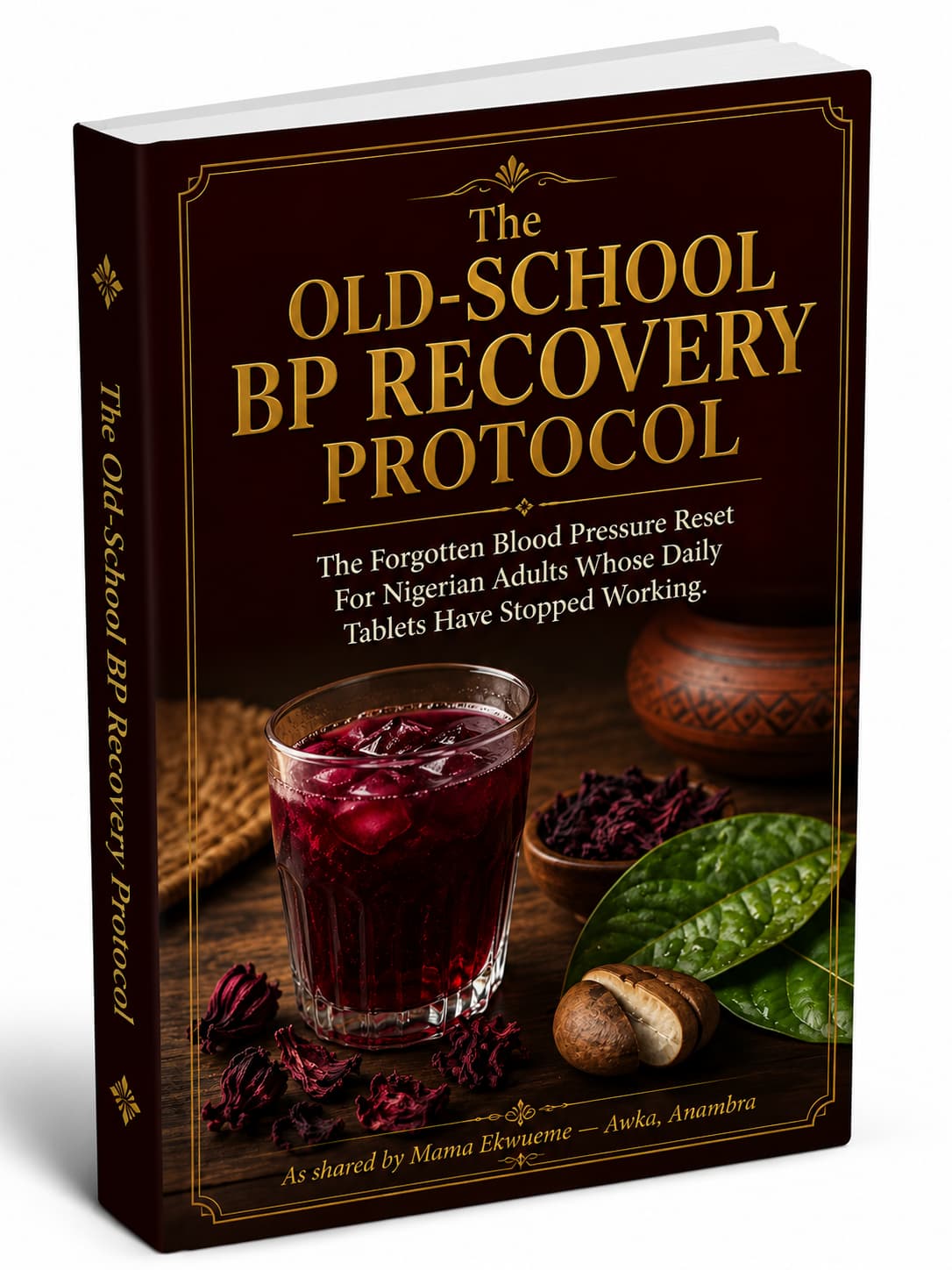
The Forgotten Blood Pressure Reset For Nigerian Adults Whose Daily Tablets Have Stopped Working
Inside this e-guide, you will discover:
- The Mama Ekwueme 3-Step Daily BP Recovery Practice — the complete protocol in exact sequence, with quantities, timing, and preparation method for every step. This is the full framework — not a summary, not a tease — exactly as it was taught. — Pg. 3
- The Plain Hibiscus Zobo Morning Preparation Guide — the precise steep time, temperature, and quantity that preserves the vasodilatory properties of dried hibiscus flowers, and why the sweetened commercial zobo you have been buying from Lagos market vendors has zero effect on your blood pressure. — Pg. 8
- The Soursop Leaf Midday Protocol — the exact preparation method, correct frequency (this is critical — not daily), and sourcing guide for fresh and dried soursop leaves available in any Nigerian market, with specific quantities that support blood vessel relaxation without interfering with your existing medication. — Pg. 13
- The Old-School Evening Wind-Down Sequence — the 15-minute structured rest practice combining the traditional sitting posture, breathing pattern, and bitter kola preparation that Igbo and Yoruba elders used to lower evening readings before "stress management" even existed as a concept. This is the step most people skip — and it is the one that transforms evening readings. — Pg. 18
- The Nigerian BP Trigger Map — which common Nigerian foods and daily habits spike blood pressure fastest, and which traditional foods actively support blood vessel health. This is not generic Western nutrition advice. This is Nigerian-food-specific, using ingredients you already buy. — Pg. 23
- The 30-Day BP Tracking Log — a daily morning and evening reading record with space for meals, protocol steps, and how your body responded. So you can see your own pattern shifting week by week — and bring real, documented evidence to your next doctor's appointment. — Pg. 28
- The Safe Nigerian BP-Support Shopping List — every ingredient and item you need to run the full Old-School protocol from Day 1, with market names, quantities, and where to find them across Lagos, Abuja, Ibadan, Port Harcourt, and Kaduna. — Pg. 32
And the best part? You do not need to book another private cardiology consultation, or starve yourself of every enjoyable Nigerian meal, or spend more money on supplements that produce no consistent results. It is the same simple method that worked for me, and has now worked for over 47 people I have quietly shared it with — friends, family members, church sisters, colleagues — all Nigerian adults aged 40 to 65, all already on medication, all looking for what their tablets alone were not giving them.
Real People. Real Testimonials. 🇳🇬
My own journey with BP is four years. I was on two tablets — amlodipine and the other one — and my evening readings were always my nightmare. I could not sleep well because I was afraid of what I would see the next morning. The evening sequence in this guide changed that for me. Week 3, my evening readings went below 138 for five days in a row. I cried. My children don't understand why I am crying — I had to explain that these are happy tears. Grateful.
I am a man so I don't usually leave these kind of comments but this one deserves it. BP na BP — it does not respect gender. I have been on medication since 2021. My readings were stubborn — 155-160 in the morning almost every day. After following this three-step protocol for 21 days, I have had five consecutive mornings below 145. My wife said she noticed I am sleeping better too. The soursop leaf protocol is very specific in the guide — please follow the exact frequency and quantity. Do not try to do it every day. Follow the guide exactly as written.
Abeg, I no know where to start. I was on three BP medications — my doctor added the third one in November last year. I was feeling defeated because I was doing everything right and the tablets were still not enough. This guide is not promising to cure you and I appreciate that honesty. What it does is it gives your body what your tablets alone cannot. By day 12 my morning reading was 139/84 — I have not seen that since 2022. I shared this with my church women's health group and four of them have already bought it.
The thing wey surprise me most is the Nigerian BP Trigger Map inside this guide. I have been avoiding the wrong things all along — cutting things that were not actually hurting my BP, while eating things every day that were silently spiking it. Nobody — not my doctor, not any website I read — gave me this information in a Nigerian-food context before. This guide is worth ten times what they are charging. Buy it before the price goes back up.
Share Your Experience
Just So You Know... Putting This Guide in an Easy-To-Read Format Cost Me Over ₦148,000
I want to be transparent with you about what went into creating this guide — because ₦9,800 is not what it cost to produce. Here is what I spent:
✔ Traditional knowledge research and elder consultation fees — multiple sessions with community health elders and traditional health practitioners across Anambra and Lagos States documenting the practices properly
✔ Igbo and Yoruba elder dietary heritage documentation — working with a cultural researcher to accurately record the traditional protocols so nothing was lost in translation
✔ Hypertension lifestyle study review — cross-referencing the traditional practices with available Nigerian and West African research on dietary blood pressure management
✔ Professional guide writing and formatting — turning my handwritten notes and research into a clean, readable, 32-page structured guide
✔ Design, layout, and digital preparation — ensuring the guide is professional, readable on mobile, and immediately downloadable
Total investment: ₦148,000
I won't even charge you ₦74,000...
Not even ₦40,000...
In fact you won't even pay
A fair price for this guide — given what it cost to create and what it has done for dozens of Nigerian adults — would honestly be ₦27,500.
One-time payment. Instant download. Yours forever.
⚡ WAIT! I Have a FREE Gift For You...
If You're Among the First 50 Buyers, You Get These Amazing BONUSES Alongside Your Package — TODAY ONLY
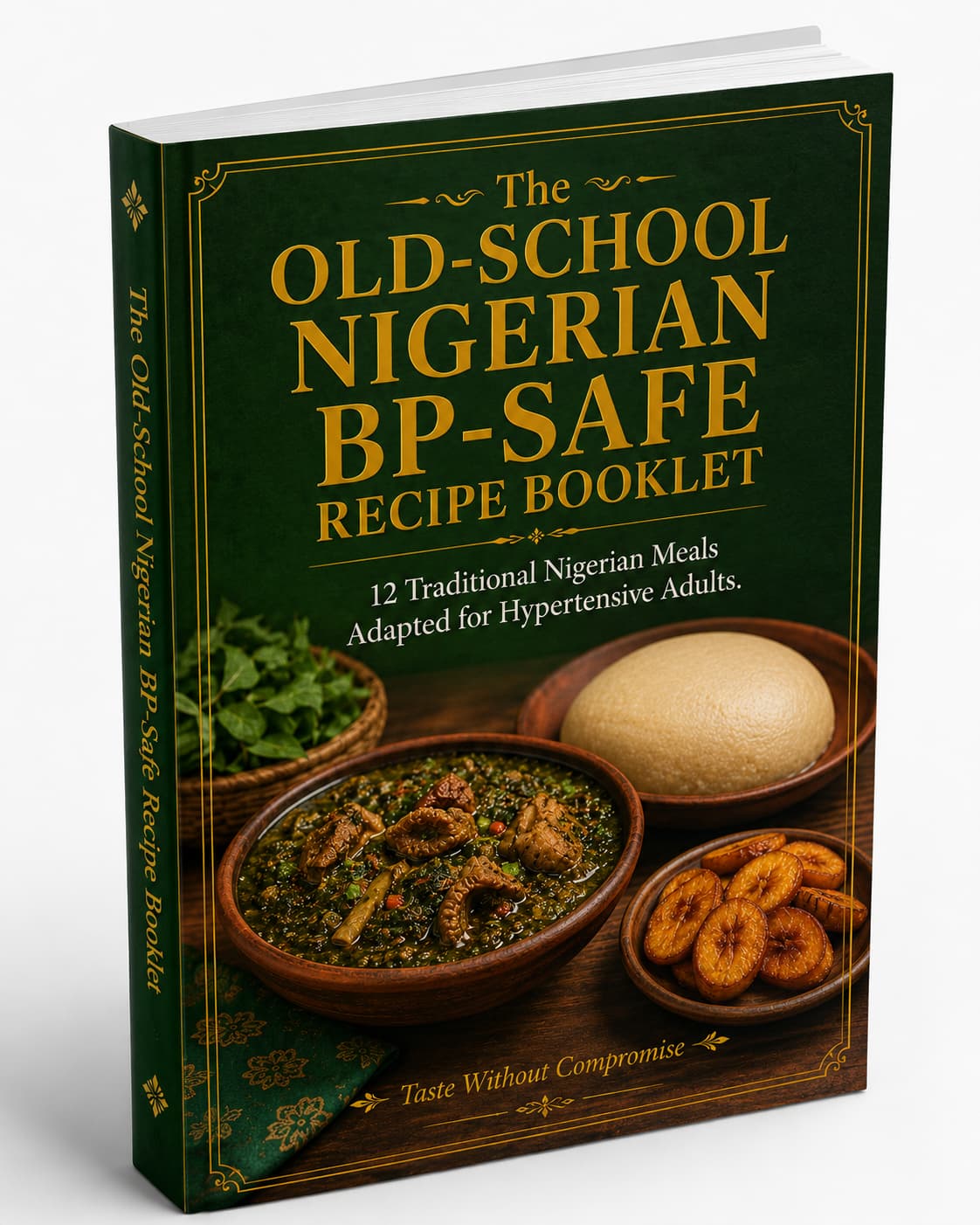
The Old-School Nigerian BP-Safe Recipe Booklet
12 traditional Nigerian meals adapted for hypertensive adults — with salt-reduction and ingredient swaps that protect your blood pressure without stripping the taste and culture from your food. No more eating joyless "healthy" meals while everyone else at the table eats properly. Your Nigerian food does not have to be your enemy. This shows you how to prepare it safely.
Value: ₦5,000 — Yours FREE
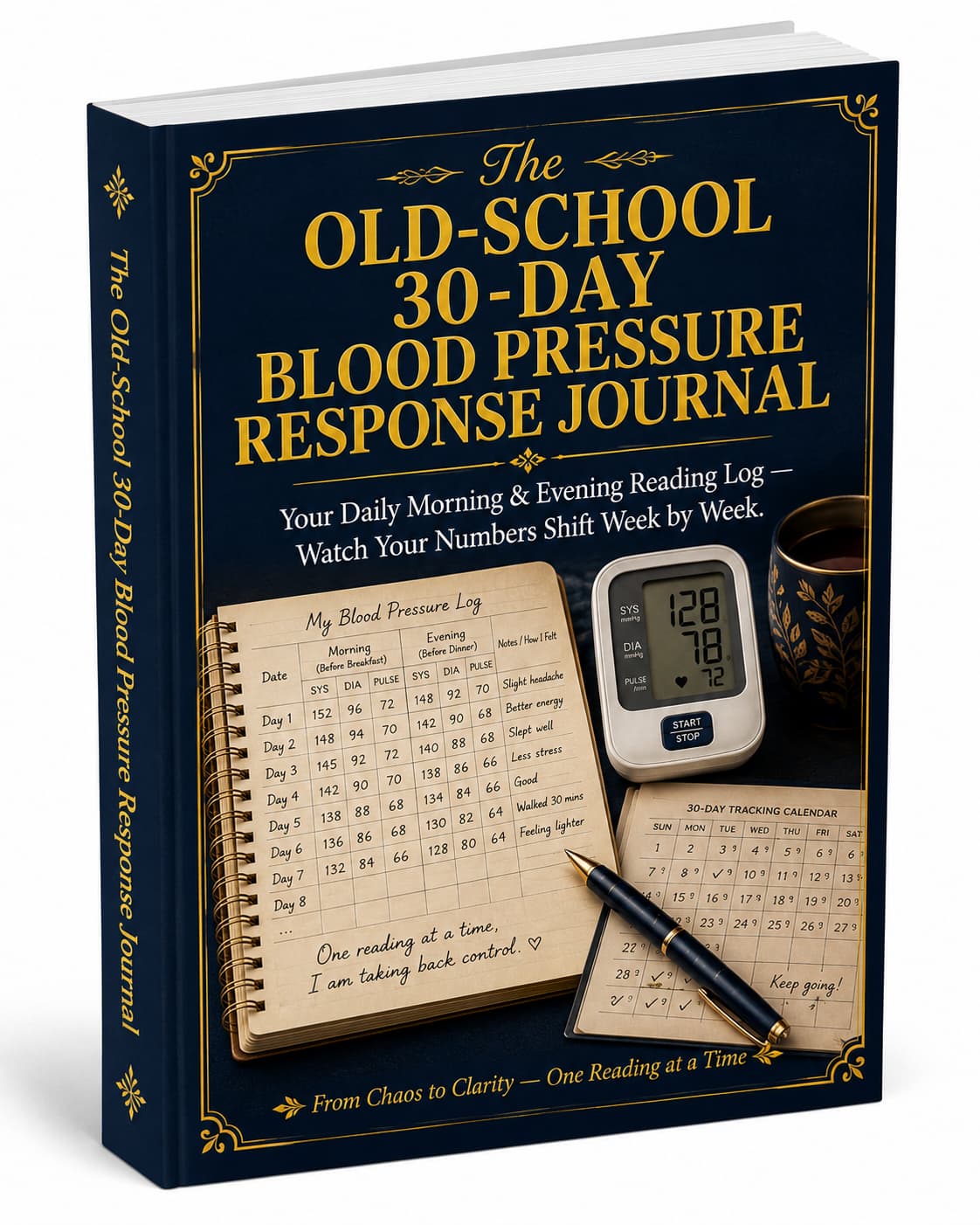
The Old-School 30-Day Blood Pressure Response Journal
A pre-filled daily tracking template where you log your morning and evening BP readings, your meals, your protocol steps, and how your body responded — day by day, week by week. So you can see your own readings shifting in real time and bring real, documented evidence to your next doctor's appointment. Your doctor will be able to see clearly what is working.
Value: ₦3,500 — Yours FREE
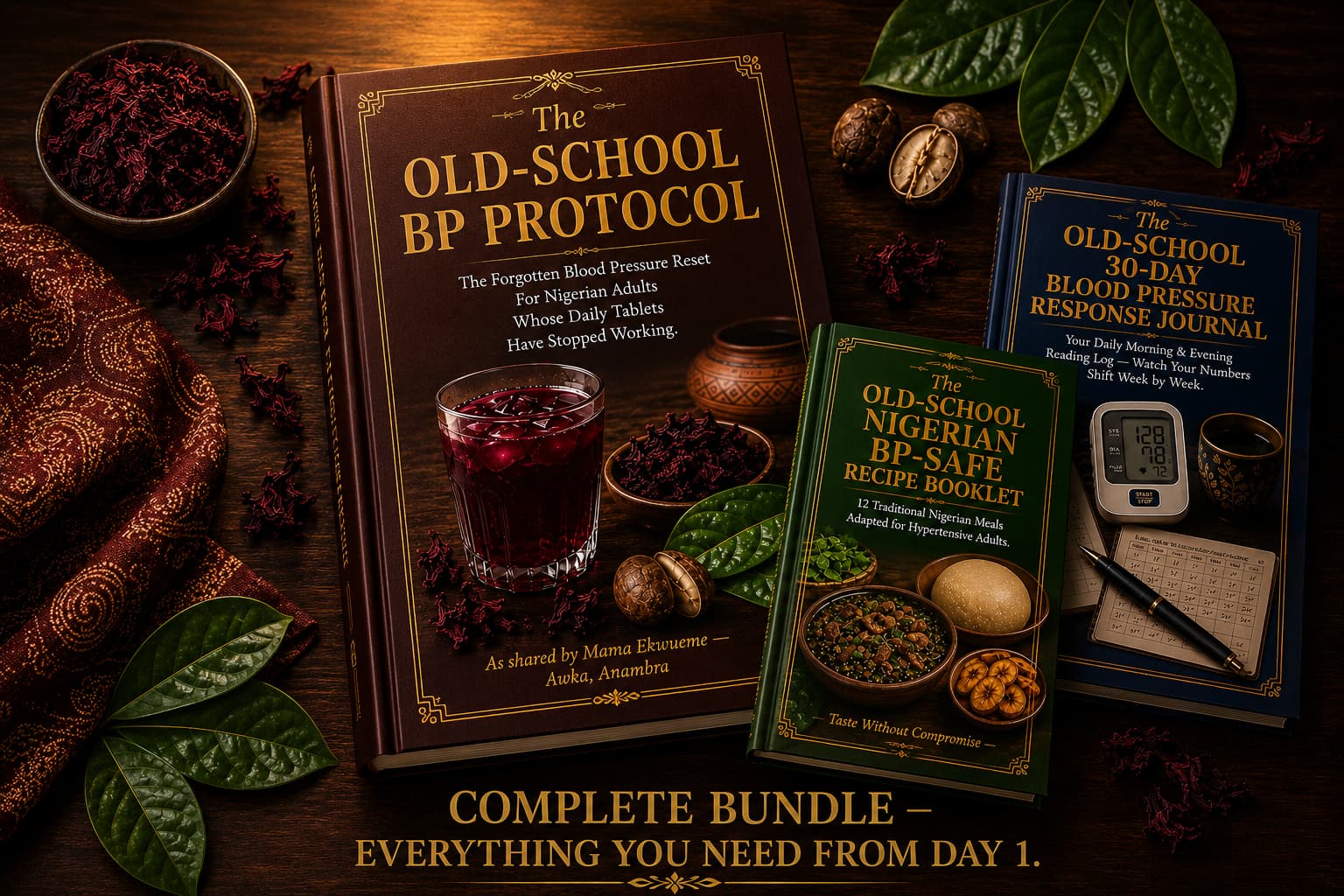
You pay just ₦9,800 today — and only if you are among the first 50 buyers.
See What Is Happening Right Now 👇
Only 19 spots remaining at ₦9,800.
Bear in mind — you are not the only one viewing this page right now.
Still Feeling Unsure? I Totally Understand.
Which is why I am making you a bold, risk-free promise:
Follow the Old-School BP Recovery Protocol for 30 full days. Prepare the plain hibiscus zobo morning drink as directed. Follow the soursop leaf midday protocol on the correct days and at the correct frequency. Do the 15-minute evening wind-down sequence as written. Log your readings in the 30-Day Tracking Log.
If your morning and evening readings have not shown measurable improvement after 30 days of following the three steps exactly as written — send me a message with your tracking log and you will receive a full refund. No questions asked. No arguments. No delays.
I am confident enough in this protocol to make that promise. Because I have seen what it does — for myself, for my cousin Adaeze, for Mrs Onyeka, and for the dozens of Nigerian adults I have quietly shared it with since Christmas 2023.
The only risk is that you keep doing what has not been working — and keep getting the same morning readings that are slowly breaking your heart.
More Nigerians Speaking Up 🇳🇬
I bought this guide with low expectations because I have tried so many things. The difference here is the structure. It is not "drink zobo and hope." It tells you exactly when, how, what temperature, what quantity, and why the market version does not work. That specificity is what makes it different from everything else I have tried. Week 2, my doctor called me to check my readings because my pharmacy records showed I had not refilled my extra supplement in a month. I told him I was trying something. He said keep doing it — your readings look better than they have in eighteen months.
As a man wey don dey check BP every morning for three years, I know say this thing is real o. My wife na the one wey buy am first — she send me the guide and say try am. I start the zobo morning prep on a Monday. By the following Friday my reading was 137/83 in the morning. That na the first time in two years wey I see that number. I come out of the bathroom and my wife see my face and she already know. She just said: "I told you." Women always know. Buy this guide — do not overthink am.
The BP Trigger Map alone is worth the price of this guide. I discovered that something I eat almost every day — something I thought was healthy — was spiking my readings. I removed it for ten days and combined it with the protocol. My evening readings dropped from consistently above 150 to consistently below 140. My husband and I eat dinner together now without me worrying about what it is doing to my numbers. That peace of mind — that is priceless. Thank you Ngozi.
I was crying when I read the opening section of this guide because she described exactly what I go through every morning — the fear before the reading, the knot in the stomach, the lying to my children about my numbers. I felt so seen. But beyond the emotional connection, the protocol is practical, specific, and it works for a Nigerian life. The ingredients are not exotic. I got everything from my local Owerri market in one trip. On Day 10 I recorded 143/87. I said thank you Lord and sent this link to three friends immediately.
My husband bought this for me and I was not interested. I have been on two BP medications for five years and I thought: what can a PDF guide do that my doctor cannot? But I tried it out of respect for my husband. By week three, I had the best readings I have had since I was diagnosed. My doctor reduced my dosage at my last appointment — he said my consistency over the month was excellent and he wanted to try giving my body more room to regulate. I am following this guide alongside my medication. It is complementary, not a replacement. And it is working.
Share Your Experience
Right now, you have two choices in front of you.
The choice is yours. But the price goes back to ₦27,500 the moment the first 50 copies are sold. And someone else is reading this same page right now.
This price is only valid for the first 50 buyers. Once the counter hits 50, it returns to ₦27,500 permanently.
📩 After payment, you will receive an instant download link by email. Check your spam folder if you do not see it within 5 minutes.
I was sceptical honestly. My husband said make I try am since everything else no work. By day 5 my morning reading was 144/89. I have not seen that number in over a year. The zobo preparation — the exact way it shows in this guide — na the one wey change everything for me. Not the market version. The proper one. My doctor appointment is next week and I cannot wait to show him my 30-day log. God bless the person that put this together.